- Are You Metaverse Ready?
- Posts
- The Metaverse's Biggest Hurdle
The Metaverse's Biggest Hurdle
It results in one of the biggest complaints about the space.

MetaverseBay
December 18, 2023
What’s up, MetaverseBay here.
We share what newcomers should know, what updates experts should know about, and what everyone may find interesting.
Let’s get down to it.

Over ¼ of the way there! The space is always changing though…
This week we’re looking at a highly technical aspect of AI and the Metaverse.
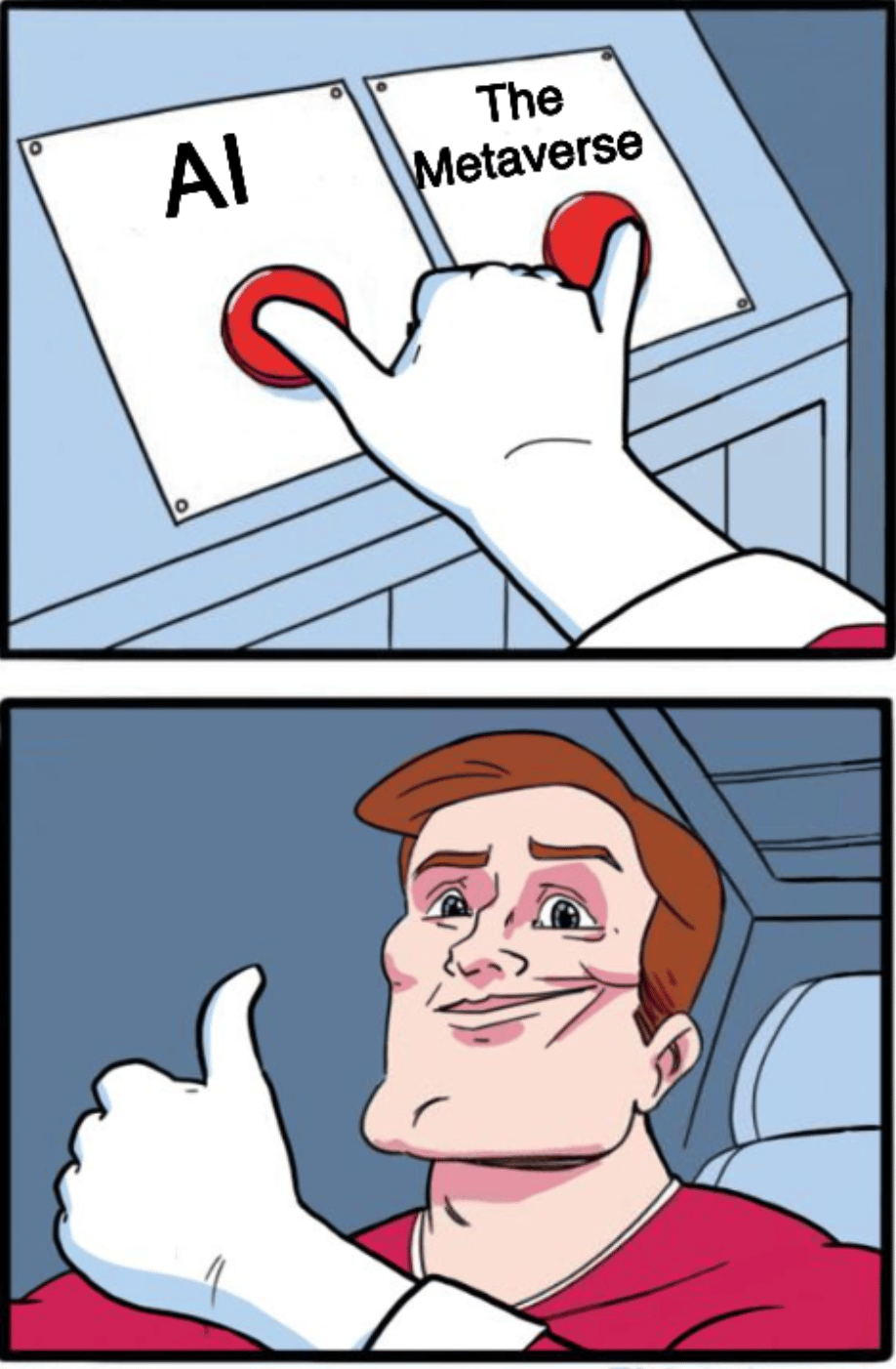
Why choose one when we need both?
There’s one big thing holding back the Metaverse and AI.
Our current technological limitations.
DISCLAIMER: None of this is financial advice. This newsletter is strictly educational and is not investment advice or a solicitation to buy or sell any assets or to make any financial decisions. Please be careful and do your own research.

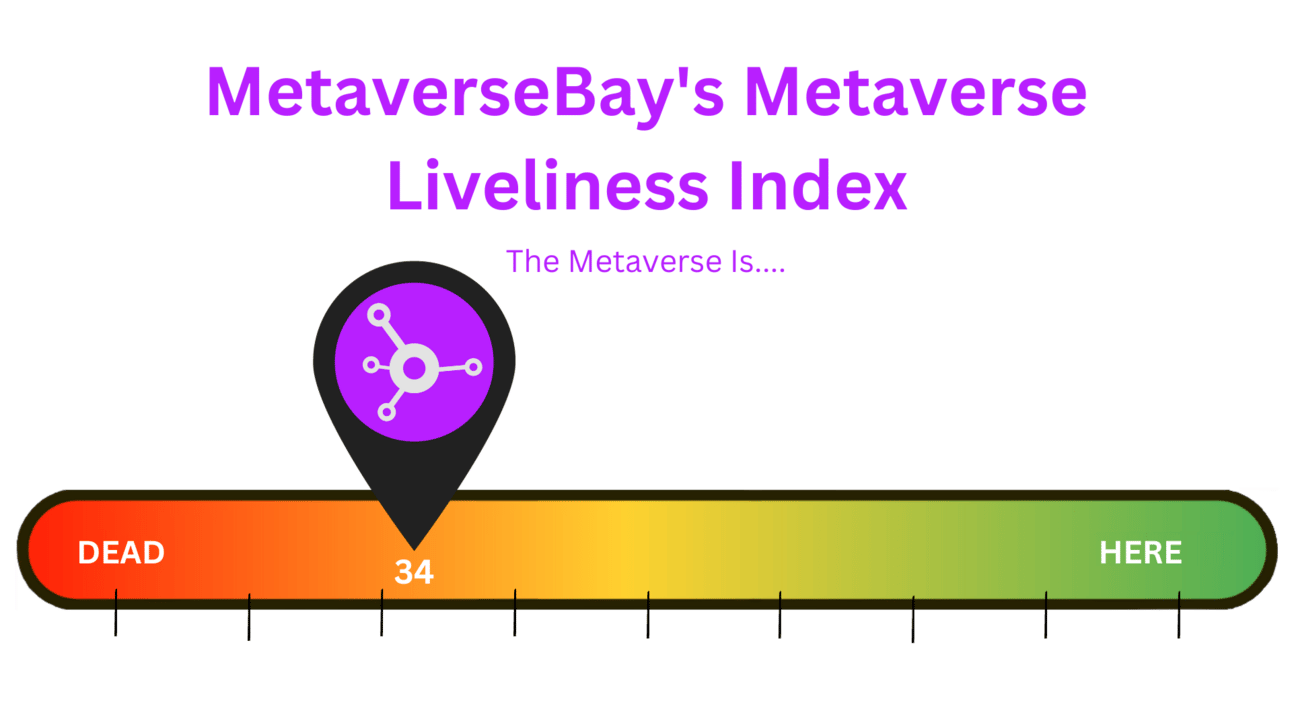
An addition to our newsletter is our Metaverse Liveliness Index.
It gives us an idea of public interest in the metaverse and how relevant it is at this moment in time.
We will publish a full length article explaining the breakdown and calculation.
The index jumped by 2 points this week to a new total of 34.
A large crypto rally is being seen, driving up the index. The MVI token index increased over 14% week over week, while our metaverse token blend jumped over 17%.
In the coming weeks we may see this rally continue or a sharp pulback. Time will tell.

This week we are touching on Throughput.
This, in our context refers to how much information can pass over the internet from one end to the other in a given period of time.
Put simply, its how much information can pass from one point to another on the internet.
Throughput allows information from one user on the metaverse to be sent over the internet to another.
If your avatar moves, speaks, or performs another action, it has to have that information sent over the internet to all others.
A higher throughput will allow for this information to be transferred more quickly and seamlessly, allowing for a less laggy experience.
If throughput is slow then the data will be transferred at a lower rate and make the experience less enjoyable.

The Challenge? Adequate Infrastructure
AI and the Metaverse have created a significant challenge for the datasphere.
The datasphere is the infrastructure that stores and processes our data. The rise of AI and the Metaverse have added growing demand and strain to it. It must evolve to meet these new demands.
FLOP/s (Floating Point Operations Per Second) are a measure of computer performance and can determine the complexity of language learning models.
The rise of machine learning has exponentially increased computational demand.
A study showed machine learning represented 15% of Google’s energy consumption and 70-80% of their FLOPs.
This correlates to a huge increase in demand for higher performing machines.
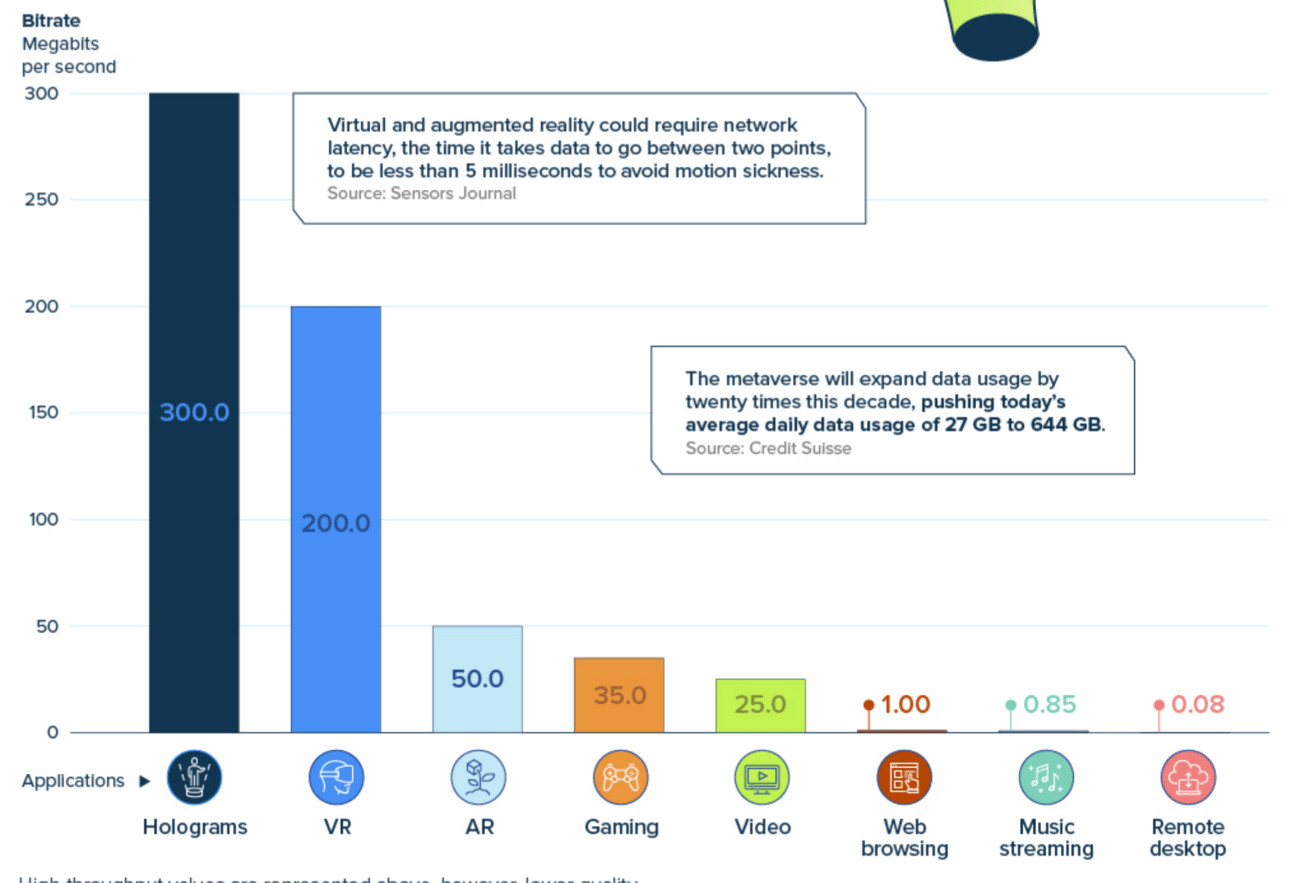
Screenshot taken from visualcapitalist.com
The Metaverse (through AR & VR) could demand a reduction in network latency to 5 ms from the average 10-12 ms to avoid motion sickness.
Slower connection speeds will cause lagging movement, sickness, and dissuade players from using devices.
At the moment our technology can struggle to meet these demands.
It will also have to handle a predicted increase in data consumption per household from 27GB/day to an estimated 644 GB/day, which can lead to network congestion.
These demands are part of the reason metaverse graphics are often cartoonish. Lower-end graphics have less demand on infrastructure than higher-end ones.
Looking forward we can already see rapid advancements towards rectifying these issues as internet speed and traffic handling capabilities increase and hardware advances.

🔴
Generative AI Has Killed the Metaverse
Hope may still exist though
🟡
Thinking of Hibernating Through the Metaverse Winter?
Some investors are scaling back and others are doubling down
🟢
Envisioning the Future of Human-Computer Interaction
A harmonious cooperation of the Metaverse and Generative AI


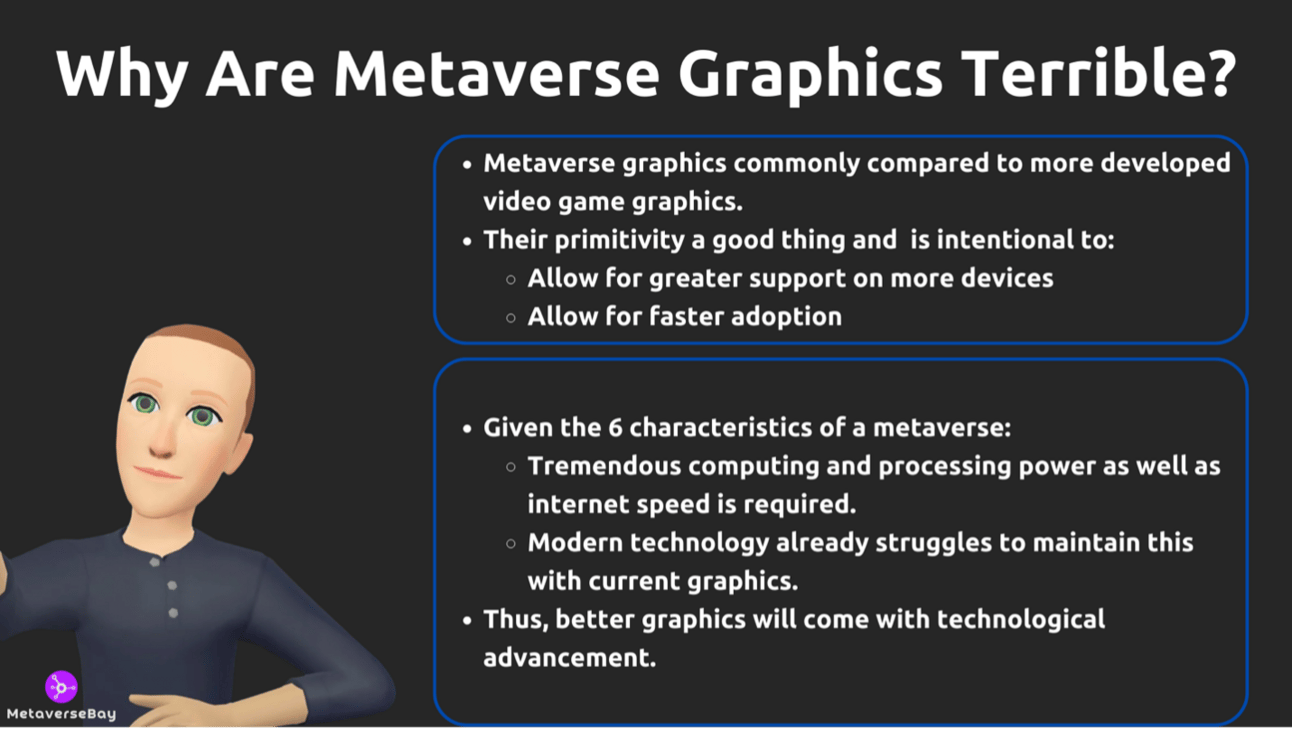
Many people question why if video game graphics are so developed, metaverse graphics look like a cartoon.
This is due to the requirement for the metaverse to be synchronous, offering real-time feedback to user actions, something which eats up tremendous amounts of bandwidth and processing power.
In addition, many users utilize their PCs, smartphones, or other capable device (aside from a specialized VR headset) to access the metaverse.
In order to make the experience as accessible and seamless for a wide variety of users, graphics have to suffer a little.
As technology advances and adoption of the metaverse space increases graphics should gradually improve as more and more users get specialized or more capable devices.
We appreciate your feedback!
One tap helps us more than you know!


This looks better every week!
Thank you for reading!

See you next week!